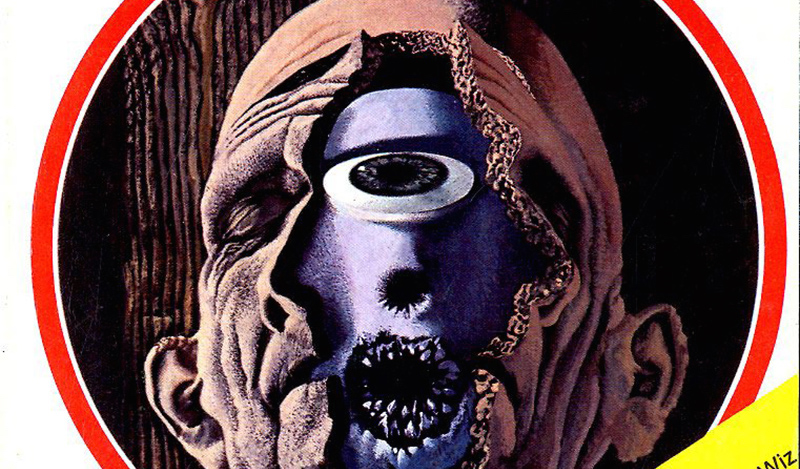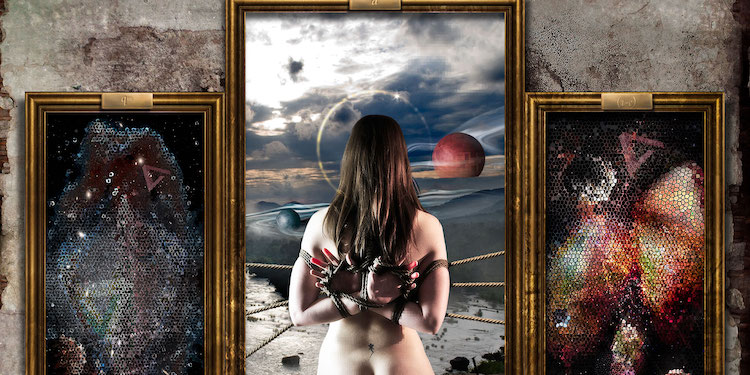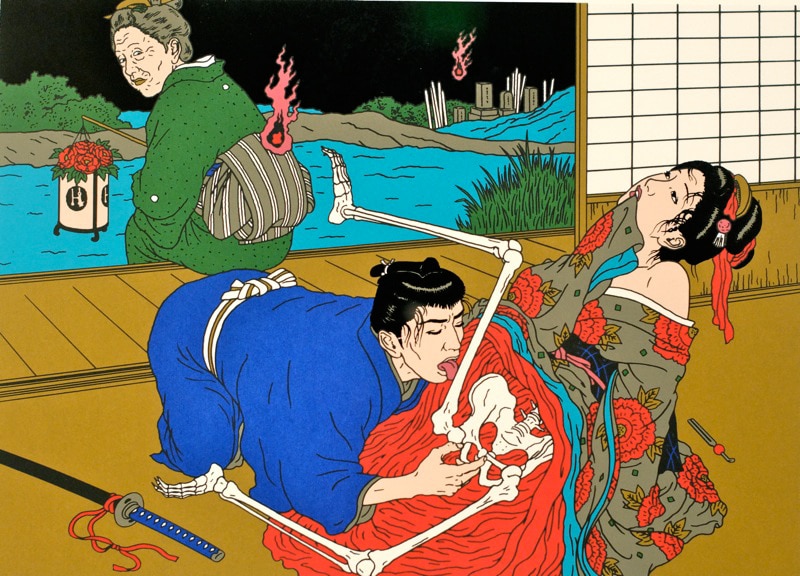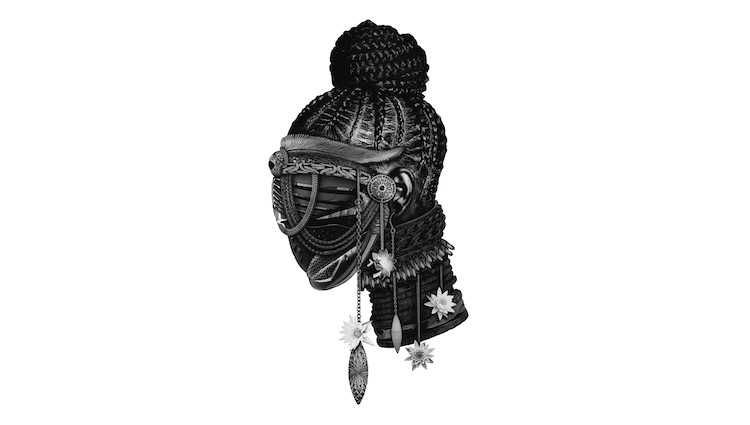
If you are in the NYC vicinity this weekend, and need a cold beer and rad art to recover from a nasty hot day, here is an event you can’t miss…and if you are in Manhattan, that means getting your ass to Brooklyn, no matter how intimidating that seems (no cabs is not an excuse!): ‘Dreams were made for Mortals’ is a one day group show happening this Sunday, July 24th, at St. Vitus Bar in Greenpoint, Brooklyn. The show is curated by the multi-talented Karlynn Holland, and is hosted by St. Vitus Bar‘s David Castillo and CVLT Nation’s favorite photographer, Samantha Marble. This show is a haven for the underground artists of NYC; Holland describes it as an “anti-art show” – no shee-shee white walls, dainty wine-sipping or obscure commentary. This is a down and dirty, beer drinking, black-walled bar show, where you will meet real awesome people and see some amazing and probably under-appreciated works by some established and some up-and-coming artists. The artists showing are Mick Barr, Lee Bartow, Dallas Erl, Jamie Foster, Grey Heart, Karlynn Holland, Suren Karapetyan, Victoria Lui, Gerry Mak, Samantha Marble, Nicholas McMaster, Brian Montuori, Angel Nacol, Nicholas Palmirotto, Owen Rundquist, Sierra Seip, Nathaniel Shannon, Nikki Sneakers, Erin Utzig, Justina Villanueva, George Wilson…these artists will be showing a whole bunch of unique and disturbing works. Some of them I have already covered on CVLT Nation, and many I will be covering in the future now that Holland has given me the heads up. Also, there will be a ton of DJs from excellent bands and blogs and I have a feeling that if you miss them, you will feel like a big loser. Below, read the inspiration behind the show, and after the jump check out a selection of preview images from the show and also get all the info you will need before you go.
Dreams, frequently, are broadcast across neural pathways in vibrant color. They are so vivid, the dreams feel more real than my waking life. It haunts me. Life feels like the dream, a series of passing moments. As I rise from paralysis, they evaporate from memory. How could something so real fade so quickly? I often find myself asking this question. Exploring the dawn hours of your fervent mind, please choose or create work that exposes our perishable nature and echoes human frailness so often deified by gods of rock and roll.
Putrid will give your nightmares nightmares. His illustration lives up to his name – he creates scenes that reek of arterial spray, disemboweled guts and brain matter, all mixed together in a gory soup. There is a massive amount of movement in his work; his subjects are surrounded by spray and ooze, and he revels in their tortured writhing and reckless massacring. Looking at his artwork, you feel their angry heat and smell the offal spewing across the page. Putrid combines his love for horror, gore and death metal to create masterpieces of disgusting beauty. He has worked with bands like Autopsy, Coffins and Impetigo, on Lunchmeat zine and Mystical Music zine, and recently for “Diary of a Deadbeat,” a documentary about cult director Jim Van Bebber. After the jump, take a good look at what evil joy looks like through the eyes of Putrid…
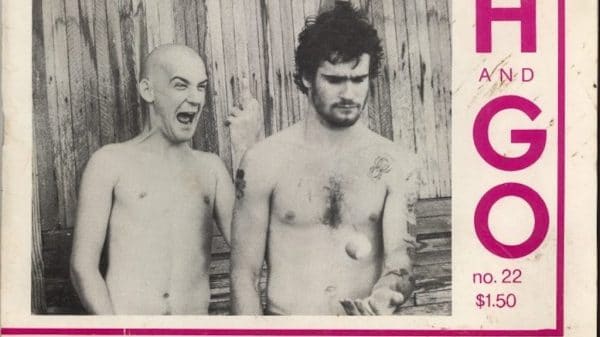
Esoterra was a zine which existed from the early 90′s up until the year 2000 chronicling the far-out of the far-out in culture. Emphasizing the importance of hidden and obscure voices, Esoterra easily found its self lodged on many bookshelves snugly between Simon Dwyer’s ‘Rapid Eye’ series, V. Vale’s ‘Re/Search’ books, and Adam Parfrey’s seminal ‘Apocalypse Culture’. Not many zines have been able to claim these important and controversial works as neighbors.
After Esoterra stopped publishing physical copies in 2000 they continued with online content. I’m not sure how many copies of each issue ever got printed but those that were became difficult to get. Lucky for us, earlier this year Creation Books published an anthology of “the best material from the magazine” – according to creator and editor Chad Hensley. Unfortunately, it’s not everything but what remains is pretty damn cool.
Esoterra: The Journal of Extreme Culture is packed to the brim with reflections on society from voices rarely heard and often ignored to the point of subtle silence. Highlights include a interviews with Adam Parfrey, Alan Moore, Iain Banks, Genesis P-Orridge, Peter Whitehead, Iain Sinclair, Boyd Rice, and Thomas Ligotti. There is also a pretty good piece on the Process Church, a piece of fiction by Thomas Ligotti entitled ‘The Nightmare Network’, Adam Parfey’s ‘Weird Sex Cults’, a short piece on necro-ethics by known necrophiliac Leilah Wendell, and some pre-Lords of Chaos pieces on Black Metal my Michael Moynihan.
Not everything within is amazing, I found myself skimming over a couple of pieces, but overall this book is fucking great. There are a couple of interviews that veer off into sketchy (or possibly sketchy) areas, but fuck, we’re talking about a book with an interview with a necrophiliac in it, so it shouldn’t come as a shock. I think that’s part of what I like about it. If you’re gonna explore “Extreme Culture” you don’t turn away because someone said something offensive. And I know people will disagree, wishing in some way to eradicate the voices and opinions that cause tension and challenge the nice, neat world we want to live in. If you feel that way, this book isn’t for you. What I really mean is that Esoterra is a well rounded exploration of the far-out, so next to the anarchist voice you have the elitist voice, next to the humanist you have the misanthropist, and next to the underground, writer/artist/musician you have the fucking necrophiliac.
Pieter Bruegel the Elder was a rebel of the 16th century, a man who embodied punk rock 400 years before the term existed. He documented the life of the peasant “working class” and dared to challenge the social structures of his time. He did so through his paintings, which ridiculed the religious and economic systems that characterized the Reformation era in Holland. On his deathbed, he asked his wife to destroy some of his most inflammatory works, so that his family would be safe from persecution. His style embodied that curious mixture of lewd and holy that seems to characterize medieval Europe. His subjects are murderous skeletons and scenes of massacre, and he obviously took great pleasure in his depictions of the Seven Deadly Sins, where a chaotic jumble of bodies twist and writhe as they fornicate and gorge themselves. His work as a definite element of satire to it, as if he is poking fun at the seriousness of religion’s rules. Just as he is able to capture the spirit of joy in his peasant dances and markets, he uses vibrant color to darken his landscapes, staining them with blood red skies and dank earth. His Tower of Babel looms high above the earth, and glows with an ominous and evil aura. After the jump, check out how medieval punk rock got down.
Paul Gerard is an architect of the world’s end…he has made the blueprints for our destruction, and he visualizes the demise of humanity through paintings, sculpture, mixed media and digital. Hailing from Liverpool, Gerrard has worked as a conceptual artist for several Hollywood films, including the recent Battle: LA, building alien bringers of death. His own original artwork is a combination of apocalypse and rebirth. His subjects materialize out of shivering mists, grow out of ancient trees, and descend from tempestuous skies. You can hear the creak and crack of dry bark as his tree spirits emerge from their solitary existence. His work can be both terrifying and darkly beautiful, portrayals of what we fear in the dark, and its’ haunting, lovely loneliness. Gerrard’s dark forests and futuristic war machines are fantastic creatures, but his techniques make them intensely realistic. His piece “Procreators” speaks eloquently of our proclivity for destruction and mayhem, and the way we turn technology into weapons – mankind flying high above us, spreading his death seed across the planet. It is a scene more profound and more threatening than any alien threat we face on the big screen. After the jump, let the damp air chill you to your bones as you enter the world of Paul Gerrard…
Looking through Brian Mercer‘s collection of tour and gig posters is like taking a long journey through a Victorian graveyard on acid. Statues of angels loom over you, starkly contrasted, ominous guardians of the underworld. Ancient bones and skulls spill out of the earth from their decrepit resting places, and rise up, drawing themselves together to recreate their lost bodies. All the while, colors swirl through the air above your head in rhythmic patterns, pulsing and waving through the fetid air and into your open brain. Mercer creates these mystical scenes for gigs, festivals and tours around the country, and has worked with bands like Eyehategod, Buzzov-en, High on Fire, Weedeater, Lamb of God, Zoroaster and many more. His posters are true collectibles, and although I wasn’t able to make it to the shows in Philly, I will be adding a few of these to my collection for sure. After the jump, enter the gates and tour through Brian Mercer’s secret graveyard…
Denis Forkas Kostromitin creates eccentric beauty with his pen, his blood, his salt and his canvases. His paintings and illustrations have a dark fury about them; they are foggy and dark, and swirl with movement that gives the viewer a sense that there is more happening in the canvas than sight alone can perceive. Indeed, his work seems to play with all of the senses, seeming to encompass the viewer with smell and taste and noise that blows against one’s skin with fetid warmth or sharp iciness. Forkas cites the art of the Ancient Greeks and the Renaissance as inspirations, but he also incorporates mysticism and ritual practices into his work. He is the genius behind Horseback’s The Invisible Mountain artwork, and more recently on their collaboration with Locrian, New Dominions. In my opinion, UTECH works with some of the dopest and most prolific artists for their releases, and has a keen eye for artists with unique styles and artistic longevity. After the jump, check out a selection of Forkas’ paintings and illustrations, and I hope you are as touched as I am.
Paul McCarroll, aka Unhinged Art, certainly brings an element of the insane to his craft. His illustration and digital painting depicts a debased and terrifying world, but at the same time he creates beautiful lines and textures in his subjects. McCarroll speaks volumes in his work, but in a subtle and complex way – while on the surface his subjects may appear grotesque to some, upon further scrutiny you will find socio-political commentary among their intertwining limbs and penetrated holes. I have been really fortunate to speak with Paul and get a better perspective on his life, art and inspirations. After the jump, read CVLT Nation’s interview with McCarroll…

Of all the times to be stuck in L.A., Santos recently showed his works in my hometown, Vancouver, at the group show ART Show, alongside another artist I covered recently, Alison Lilly, and a few other artists I will definitely be checking out in the near future. Santos is a heavyweight when it comes to quality of illustration for the metal community. He has done a ton of work for Kylesa, and has made amazing artwork for bands like High on Fire, Lamb of God, Noisear and many more. Santos is a master of symmetry down to the smallest details. His illustration ventures into a dark landscape, where death and destruction reflect back on themselves in evil symmetry. His pieces are highly detailed Rorschach tests, coming to life under your gaze and drawing you into the disturbing visions you are beholding. Each piece is highly detailed and a myriad of textures, and his black and white illustrations appear as if they are a cacophony of color. They explode with with movement – leaping out from the page (or screen), crackling and writhing, bursting with the sounds of growth. His artwork is moving, and while I am excited by what I see on screen, his pieces really need to be giant to fully appreciate the work he puts into each square inch. Hopefully some time in the near future I will be able to appreciate his artwork in person. Until then, check out a selection of his pieces after the jump…
Chris Tianto, aka Goathead, holds it down for CVLT Nation in Southeast Asia from his native Indonesia, bringing us a point of view from one of the hubs of metal culture on the other side of the world. He is a purveyor of dark art, in the form of digital photomanipulation and collage. While Goathead’s medium may be digital, his building blocks are analog and Polaroid photography. His work has an emerging quality to it – the images seem to be rising from the page as you look at them, like dark apparitions appearing on weathered book pages, stained concrete walls or rusty metal sheeting in a barrio somewhere. The textured canvas is as much a part of the images as the subject on it, and lends an atmosphere of sinister antiquity to his work. It almost seems like I am looking at stills from a really disturbing turn of the century film – something that was hidden away to collect dust and scratches, only to be pulled out of some shameful, secretive past. One of the pieces that speaks to me is his Death’s Head moth priest, standing on a pile of human bones. The priest smiles out at you from behind the dirty window of time, and the realism of the image makes it seem as if he is looking into your soul. After the jump, explore the parallel universe created by Goathead through a collection of his works…