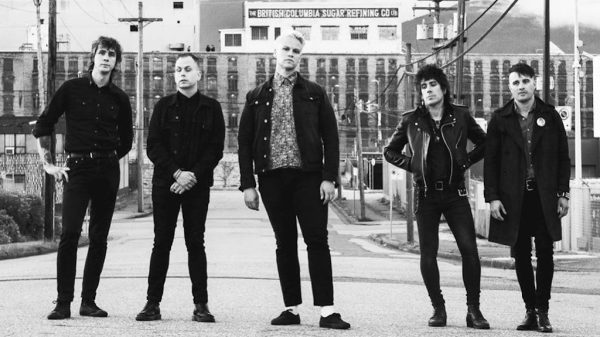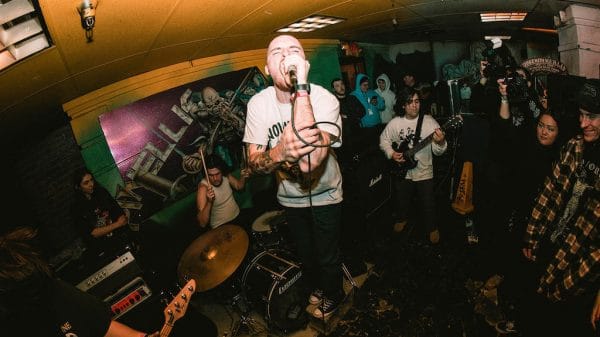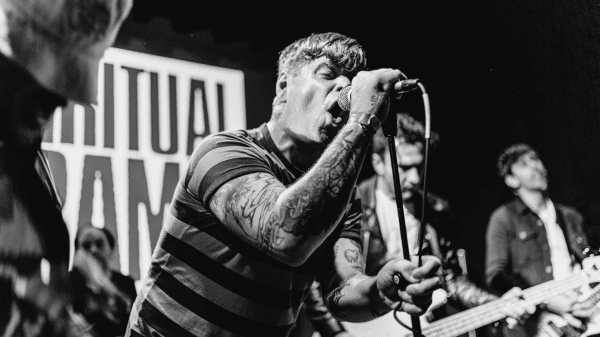
Arctic Flowers’ Reveries LP (Inimical Records) was easily one of the finest punk records of 2011. With a new EP, “Procession,” coming up in advance of an East Coast tour in August, things are going good for Arctic Flowers. The Portland quartet play a type of gothy peace punk that, unlike some bands in this genre, is not afraid to go at faster tempos. “Our sound is a mix of punk, deathrock, post punk, and goth,” guitarist Stan Wright explains. “Aggressive but at times danceable and melodic.” Arctic Flowers’ powerful combination of these elements makes them one of the most exciting bands around today.
Interviewed below are vocalist Alex, guitarist Stan, and bassist Lee.
Creatures interviews Skinfather.
First off, where did you get the band’s name?
We got it from a Dismember song. Most of us are inspired by death metal bands. We originally had about 5 different band names floating around, and this one always stuck out from the rest.
Can you give me a more in-depth opinion on your lyrics, the subjects you talk about and why you feel that way?
Lyrically, we try to portray a secular perspective. All of our lyrics deal with Atheism in some way. We felt like too many bands out there were preaching satanic views, even though they don’t really believe in it. A few of our members are religious, but for the ones that are atheist, the lyrics explain the distain we have for organized religion and faith in general.

Photos by Michael Sogoff
READ MORE…
Interview with Jon Davis of Conan
by Metaloath
Conan (UK) has decisively built their fortress of doom metal. In just 2 years, they have laid out foundations of their stronghold: Horseback Battle Hammer (2010, Aurora Boralis), Conan vs Slomatics (2011, split w/Slomatics, Burning World Records) and the latest Monnos (2012, Burning World Records). The band now counts Jon Davis (guitars), Phil Coumbe (bass), and Paul O’Neill (drums), and they’re situated in the Liverpool-areas, UK.
The modus operandi of Conan range from the raw, muddy tremble of instruments tuned way low to the carefully constructed heavy tones and riffing while the lyrics paint the landscape of ancient warfare and grand moments in battle. They have stuck with Chris Fielding at Foel Studios (Electric Wizard, Primoridal, Cerebral Bore) as their producer, and he has nurtured the doomed souls of this trio to near-perfection in just three albums.
BY 2012, Conan is gaining serious momentum in the European metal scene. The reviews of Monnos (2012) is proving consistently positive, they have done their first set of show across Europe, and to top that off, Voivod themselves handpicked these guys to play at Roadburn festival. In Oslo, Conan was flown in as support act when Sleep brought their weedological European tour to town.
READ MORE…
Interview by Wes Cueto [graveyarns]
Maryland bands never fall short on extremity. STRONG INTENTION have been punishing the underground with their own blend of New York influenced hardcore and Southern fried sludgy grind since the mid-ninties. They have an extensive and solid catalog of releases behind them and their range as a band shines through their variation of styles from record to record. Their first demo, What’s At Stake? (1994), sounds very much influenced by late 80′s/early 90′s New York hardcore punk bands like Token Entry and Warzone. The self-titled 7″ EP contained much more speed and a heavy grindcore influence, similar to a band like Brutal Truth. Carrying that same approach forward with them, Strong Intention released the Extermination Vision and What Else Can We Do… full-lengths, a ten song 7″ in pure Negative Approach fashion entitled Each Day Lived As An Act Of Defiance… love that title… plus a split with the German group Y all squeezed between 2000-02. Their unique crossover sound has allowed Strong Intention the longevity to play out and tour with such undisputed acts as Disfear, Phobia, E.N.T., Rotten Sound, D.R.I., and Lock-Up, among many others over their extensive career but they’re just getting started. After touring for many years the band finally went into the studio to record new material which will finally see the light of day in the form of the Razorblade Express 7″ and an as yet untitled full-length. Razorblade Express is no exception to the band’s solid catalog. Six malicious tracks quickly pummel through this record like running a hot knife through butter or taking a piss in the snow. The title track to Razorblade Express, which features a brilliant performance by Mike IX Williams of Eyehategod, Arson Anthem and Outlaw Order is a real sludgefest and a severe contrast to the five other nasty cuts which display the perfect “in your face” hardcore approach which only an East Coast band can ever truly achieve on record.
I had a chance to talk with Strong Intention vocalist Zac Ohler and Mike IX about their intentions with this new record.
Enjoy the interview after the jump!
READ MORE…
“Things that anger me make me happy, ‘no hope, no future’ kinda shit” – Yeap, frontman of KROMOSOM.
Noisier, nastier and rawer. This is the doctrine that Australian punks KROMOSOM live by. Borne from the ashes of Pisschrist, the dirty crust roots of this longstanding outfit paved the way for a more stripped down approach. One that holds chaos supreme.
Built from a passion for ‘80s hardcore, the Melbourne four-piece took their strong Scandinavian and Japanese groundings and pushed them to the foray. Unveiling their debut self-titled LP last year, a recent 7-inch on Holy Terror Records sees the band taking a more melodic approach.
CVLT Nation talked to frontman Yeap shortly after its release.
Note: This interview originally appeared at the No Doves Fly Here website.
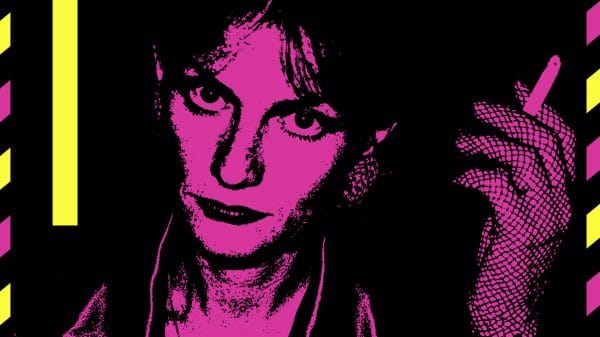
New PDX band Dead Cult have never used the word “deathrock” to describe their sound, preferring instead the term “anarcho darkwave.” Reminiscent at times of Hysteria, Rubella Ballet, or maybe even Skeletal Family, the music — whatever label you choose to apply to it — is exceptionally good, especially for a band this young. Guitar-driven postpunk rock from the dark side.
It’s hard to believe that Dead Cult has existed for just over half a year. When listening to their tracks, many of which are available freely on Youtube, and some of which are below, I was surprised to find out how young the band were. The musicianship, confidence in the vocals, etc., is far beyond the band’s years. Dead Cult have a Facebook page here; most pictures below are from that.
The S-Haters were a British dark punk band that existed from about 1976 until 1985. They played — well in advance of the trend — a type of gothy punk rock that would later be called, by others, “deathrock,” “gothic punk,” or just “goth.” In many ways the band has never gotten their due.
The original lineup featured Nick Blinko of anarcho-deathrock band Rudimentary Peni, and in fact the S-Haters started out on Outer Himmalayan Records, the label owned by Rudimentary Peni. Despite releasing four EPs, 1 LP, and having appearances on various goth-punk compilations, the S-Haters are still strangely unknown. In fact, while Ian Glasper’s excellent and very recommended The Day the Country Died included interviews with some anarcho-affiliated deathrock bands like Part 1, the S-Haters, who were also affiliated with the anarcho-punk scene, were not featured in that book — despite their having played the Crass-affiliated Autonomy Centre and actually having a much lengthier discography than many bands in The Day the Country Died.
So here is an in-depth interview with S-Haters’ singer, Kieron O’Neill, and guitarist Kevin O’Brien, at long last.
S-Haters singer Kieron O’Neill was interviewed by Oliver in June, 2012. The interview with guitarist Kevin O’Brien was done in 2006 for the now defunct Cultpunk website.
Panopticon’s latest release Kentucky threw up a great many questions as to it’s origin and meaning to creator Austin Lunn. We are honoured to have had Lunn talk to us and explain a little about Kentucky, it’s evolution, his influences and last years stellar Social Disservices.
CVLT Nation: Kentucky comes quite soon after last years Social Disservices; were they recorded at the same time/in quick succession, or were they completely separate?
Panopticon/A.Lunn: The sessions were kind of crossed over. I am one of those folks who writes and records on whim and emotion. When I was recording SD (Social Disservices) I was really pissed off and frustrated with some things and took it out on the recording. Spring came around and I began to feel like I had gotten some things off of my chest, so as I was laying the final touches on SD, I began the writing and recording for Kentucky. Kentucky is a more thought out album I think. I spent a lot longer on it…the performances are a bit more refined and I think I was a bit more clear headed when I was working on the album.
CVLT Nation: The two records have quite different sounds, was this an evolution based on the subject matter or had you made a decision to put out two countering works?
Panopticon/A.Lunn: I tend to tailor the songs to the inspiration and subject matter. SD was angry and dark because the things I was writing about are unsettling issues. Not to say that worker exploitation and mountain top removal are happy fuckin’ go lucky, they certainly are grave issues; BUT the album (Kentucky) has a more passionate, rather than depraved feel to it (unlike SD, which I think is a bit more sinister). I guess you could say the works are countering if you wanted to, but really they are just exaggerations of things I already did, just delving into those aspects a bit more in depth.
(Hit the jump to continue reading).
(Note: This interview first appeared at the No Doves Fly Here site a few months ago.)
The Bay Area’s Alaric have received positive attention on CVLT Nation before; their recent split with Atriarch, reviewed here, was amazing. Members have played in such great bands as Noothgrush, Dead and Gone, and Cross Stitched Eyes. Alaric themselves, however, have a darker, more postpunk approach to music that takes as many sonic cues from bands like Part 1, Killing Joke, or Amebix as it does from any previous projects members have been involved with. The band have been playing a lot of shows with deathrock bands like Fangs on Fur and Altar de Fey. Alaric’s music is a melancholy, downtempo, introspective form of hardened postpunk that marks a new and distinct turn from the sound of members’ bands in the past. They’ve been one of my favorite current projects and I can’t wait to see where they will go next in their sonic evolution.
This is an interview with Shane, Alaric’s singer, and Rick, the bassist. Thanks to Jason Willer, drummer of Alaric and also singer of Cross Stitched Eyes, for help with this interview.
What would it sound like if Killing Joke and Motorhead had collaborated in 1982? You know, when Killing Joke were working on their apocalyptic, postpunk Revelations LP and when Motorhead were coming off the ungodly high of having finished their Ace of Spades masterpiece? You could argue that Montreal’s The Complications (named after a Killing Joke song, in fact) are one possibility. Post-punk d-beat? Whatever it is, it’s awesome.
This is an interview I did with The Complications in 2006 at my now-defunct Cultpunk site. But it’s still as timely as ever. At that time, in 2006, The Complications were billed as a side-project of Canadian d-beat monsters Born Dead Icons, a great band that I had the good fortune to see (and photograph) a few years before that, in Texas. In fact, The Complications did start as a more postpunk-oriented side project of Born Dead Icons. The Complications did eventually succeed the Born Dead Icons, however, and their self-titled LP finally came out in 2010 on Feral Ward, though it was recorded in 2007. I was lucky enough to get to interview them during that period.